Subscribe to NESCA Notes

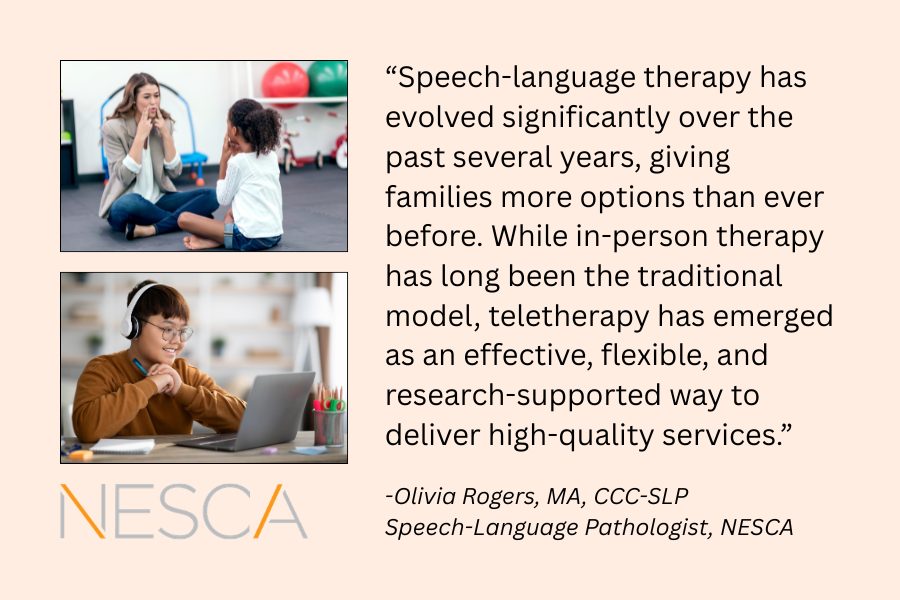
image of multiple students in a school based speech session vs a private one on one session

School Speech-Language Services vs. Private Speech-Language Services

By | NESCA Notes 2026

image of multiple students in a school based speech session vs a private one on one sessionBy Olivia Rogers, MA, CCC-SLP
Speech-Language Pathologist, NESCA

Understanding the Difference
Speech-language support can be life-changing for students, helping them by improving communication, academic access, confidence, and independence. Families often wonder whether school-based speech therapy is enough, or if private services might better meet their child’s needs. Both models provide valuable support, but they serve different purposes. Understanding these differences helps families make informed decisions.

The Role of School Speech-Language Services
School speech-language pathologists (SLPs) help students access their education. Services are designed to support academic participation rather than address every area of communication difficulty.

School SLPs often manage large caseloads, group therapy, strict eligibility criteria, and limited session frequency. Therapy typically focuses on what is necessary for a student to function at school – not always what would be most beneficial for overall communication growth.

What Private Speech-Language Services Offer
Private speech-language services allow therapy to be individualized based on the student’s whole profile. Sessions can be one-to-one, more frequent, and flexible. Goals often extend beyond minimum academic access and may integrate language, literacy, and executive functioning.

Importantly, students do not need to “qualify” for private services. Support can begin based on functional concerns, prevention, or a family or client’s desire for more targeted growth.

Why Families Use Both
Many students benefit from a combined approach. School services ensure educational access, while private services deepen skill development and allow more intensive work on underlying skills.

Quality vs. Capacity
The difference between school and private therapy is often capacity. Private therapy provides more time for practice, feedback, collaboration, and personalization, which can support faster progress and stronger carryover.

Take It From Me – I’ve Been on Both Sides
Having worked inside public schools and now providing private services, I’ve seen how system limitations impact therapy. School therapy is essential in some cases, but private services create space to address skills more deeply.

When Private Services May Be Helpful
Families often explore private therapy when progress feels slow, their child does not qualify for school services, needs extend beyond speech sounds, literacy overlaps with language, or they want more individualized or preventative support.

Final Thoughts
School speech-language services are designed to ensure access to the curriculum. Private speech-language services are designed to optimize growth. Both are valuable and work best when coordinated.

At NESCA, our speech language pathologists have been in both settings. They provide individualized, contextualized, functional, and curriculum-based support to facilitate generalization to the real world.  For more information on Speech and Language Therapy at NESCA, please complete our online Inquiry/Intake Form or email me directly at orogers@nesca-newton.com.


 About the AuthorOlivia Rogers

Olivia Rogers is a licensed speech-language pathologist with experience in pediatric clinics and public schools, working with children from age 2 through young adulthood across a range of communication challenges. With a special interest in the connection between oral language and literacy, Ms. Rogers is trained in the Orton-Gillingham method and the Brain Frames program, supporting students in language comprehension, expression, and written organization. She is dedicated to making therapy engaging and personalized for each child.

To learn more about NESCA’s Speech and Language Services or schedule appointments, complete our online Intake Form or email orogers@nesca-newton.com.


NESCA is a pediatric neuropsychology and related services practice with offices in Newton, Plainville, and Hingham, Massachusetts; Londonderry, New Hampshire; and Coral Gables, Florida, serving clients from infancy through young adulthood and their families. For more information, please email info@nesca-newton.com or call 617-658-9800.
 

Image of a signpost with the words Wait and See" and "Check It Out" on it and a quote from Dr. Rebecca Dautoff

When In Doubt, Check it Out

By | NESCA Notes 2025

Image of a signpost with the words Wait and See" and "Check It Out" on it and a quote from Dr. Rebecca DautoffBy: Rebecca Dautoff, Psy.D.
Pediatric Neuropsychologist, NESCA

As a child psychologist, I regularly advise parents that our job is not to eliminate their children’s frustration, anxiety, and disappointment. Instead, our goal is to help kids process and tolerate these emotions. In fact, it’s critical that children face obstacles so they can learn to navigate and endure challenges throughout their life. But what happens when a child has a particularly tough time at school or a really difficult year? What are the next steps?

Deciding what to do can be a hard decision for concerned parents. Some parents question whether they should  “do something” to help the child, or to relieve their own anxiety and guilt. Other parents feel that their child’s issues are due to “a bad fit” with a particular teacher or classroom structure. This can be even harder when the school tells parents that everything is okay, or it’s just a phase that they see all the time. In some cases—such as a child grieving or adjusting to a new school—a short observation period (a few weeks) with close monitoring and open communication can be appropriate. However, this should always come with a clear plan to seek help if things don’t improve, because the “wait and see” approach can pose real risks to a child’s development, mental health, and emotional well-being. Here’s why:

First, childhood is full of developmental windows. These are essentially periods of time or opportunity when the brain is especially receptive to learning a specific skill. If a child is struggling in one of these areas and we wait too long, we risk missing this period of optimal learning. Language delays are a clear example. There is a critical period of language development before the age of 3, meaning that intervention for speech and language challenges are most effective before this age.

Second, children are incredibly perceptive. Kids are highly attuned and hyper aware when they feel like something is harder for them than it is for their friends and classmates. Often, kids internalize their struggles as personal failures. This can lead to frustration, anxiety, withdrawal, or behavioral problems/acting out. These outcomes are even more likely if a child is late to learn a skill. Take reading as an example. If a child is learning to read more slowly than their peers in first or second grade, they are less likely to internalize this as a problem because most of their classmates are also learning to read. It might come more easily to their friends, but they are all learning to read. If we wait to intervene, and a child is still having difficulty with reading in fourth grade, they are more likely to internalize their difficulty as a personal failure because they are no longer surrounded by peers who are also working on the same skill.

Taking a wait and see approach with your child’s mental health can feel like a cautious or hopeful strategy—especially when you’re unsure if something is truly wrong. Unfortunately, mental health conditions are often progressive, and waiting to treat them can allow symptoms to worsen, which makes them harder to treat. Undiagnosed mental health issues can lead to poor academics, social withdrawal, bullying, or acting out. The child may fall behind developmentally or struggle to make or keep friendships, which will impact their self-esteem and exacerbate their mental health issues. In older children and adolescents, we also see untreated mental health issues lead to more dangerous problems, like substance use, self-harm, eating disorders, or suicidal thoughts.

Instead of waiting, parents should proactively communicate with teachers, seek professional help when needed, and consider the child’s overall well-being when making decisions about their education.

What to Do Instead Of “Wait and See”:

  • Talk to your child: Open the door to conversation and let them know you’re there.
  • Keep track of behaviors, moods, or changes.
  • When in doubt, check it out: Even a single consultation with a pediatrician, school counselor, or therapist can provide guidance without committing to long-term treatment. If you suspect there is a deeper learning, emotional, developmental, or behavioral issue, a neuropsychological evaluation can also determine the root cause of the issues and set you and your child on a better path forward.


About the Author

Dr. Rebecca Dautoff provides comprehensive neuropsychological and psychological (projective) evaluation services for children, adolescents,Headshot of Rebecca Dautoff, Psy.D. and young adults who have complex presentations with a wide range of concerns, including attention deficit disorders, psychiatric disorders, intellectual disabilities, and autism spectrum disorders (ASD). She also values collaboration with families and outside providers to facilitate supports and services that are tailored to each child’s specific needs.


If you are interested in booking an appointment for an evaluation with Dr. Dautoff or another NESCA neuropsychologist/clinician, please fill out and submit our online intake form


NESCA is a pediatric neuropsychology practice and integrative treatment center with offices in Newton, Plainville, and Hingham, Massachusetts; Londonderry, New Hampshire; the greater Burlington, Vermont region, serving clients from infancy through young adulthood and their families. For more information, please email info@nesca-newton.com or call 617-658-9800.

Image showing that word recognition multiplied by language comprehension equals reading comprehension and quote by Olivia Rogers, NESCA SLP

Reading Comprehension & the SLP: Why Meaning Is Our Specialty

By | NESCA Notes 2026

Image showing that word recognition multiplied by language comprehension equals reading comprehension and quote by Olivia Rogers, NESCA SLPBy Olivia Rogers, MA, CCC-SLP
Speech-Language Pathologist, NESCA

When people think about reading support, they often think of phonics or decoding. While decoding is essential, it is only one piece of the puzzle. Reading comprehension, or the ability to understand, interpret, and make meaning from text, is deeply rooted in language. And language is the expertise of Speech-Language Pathologists, SLPs.

Image Courtesy of NESCAimage showing what reading comprehension is comprised of

Reading Comprehension Is Language

  • Understanding vocabulary
  • Processing complex sentences
  • Holding information in working memory
  • Making inferences – Connecting ideas across paragraphs
  • Monitoring understanding

These are not just reading skills. They are oral language and executive functioning skills applied to print. Students can decode fluently and still struggle to answer questions, retell a story, or explain the main idea because comprehension depends on background knowledge, syntax, semantics, and discourse-level language.

Why SLPs Are Uniquely Equipped

  • Sentence structure (syntax)
  • Word meaning and relationships (semantics)
  • Narrative organization
  • Inferencing and pragmatic understanding
  • Working memory and language processing

SLPs explicitly teach the language structures that make comprehension possible rather than simply asking comprehension questions.

Evidence-based Approach: Visualizing and Verbalizing®

While support is individualized, one program that SLPs frequently use is Visualizing and Verbalizing®, developed by Lindamood-Bell Learning Processes. Visualizing and Verbalizing® focuses on strengthening a student’s ability to create mental imagery while reading or listening – a skill strongly correlated with comprehension.

  • Improves memory for details
  • Strengthens understanding of cause and effect
  • Builds inferencing skills
  • Supports organized retell
  • Deepens vocabulary understanding

Instead of passively decoding, students actively build a movie in their mind – increasing both engagement and comprehension.

When Students May Need Language-based Comprehension Support

  • Reads fluently but cannot explain what was read
  • Struggles with inferencing
  • Provides vague or disorganized retells
  • Has difficulty identifying story grammar elements (character, setting, problem, etc.)
  • Has difficulty answering why and how questions
  • Avoids longer texts
  • Has a history of language delay or concurring language disorder

Reading is not just decoding. It is meaning. And meaning lives in language. When SLPs integrate structured, evidence-based approaches like Visualizing and Verbalizing® with explicit language intervention, we strengthen the cognitive-linguistic foundation that allows reading to truly make sense.

At NESCA, our therapists use a comprehensive approach to treat the systems of learning as integrative, helping students develop valuable skills they can use in and out of the classroom! For more information on Speech and Language Therapy, Literacy, and Executive Functioning Support at NESCA, please complete our online Inquiry/Intake Form or email me directly at orogers@nesca-newton.com.


About the AuthorOlivia Rogers

Olivia Rogers is a licensed speech-language pathologist with experience in pediatric clinics and public schools, working with children from age 2 through young adulthood across a range of communication challenges. With a special interest in the connection between oral language and literacy, Ms. Rogers is trained in the Orton-Gillingham method and the Brain Frames program, supporting students in language comprehension, expression, and written organization. She is dedicated to making therapy engaging and personalized for each child.


To learn more about NESCA’s Speech and Language Services or schedule appointments, complete our online Intake Form or email orogers@nesca-newton.com.


NESCA is a pediatric neuropsychology and related services practice with offices in Newton, Plainville, and Hingham, Massachusetts; Londonderry, New Hampshire; and Coral Gables, Florida, serving clients from infancy through young adulthood and their families. For more information, please email info@nesca-newton.com or call 617-658-9800.


Image of a Neuropsychological Evaluation Report with the question, What's Next? There is also a quote from Dr. Maggie Rodriguez

Navigating Life After a Neuropsychological Evaluation: What Comes Next?

By | NESCA Notes 2026

Image of a Neuropsychological Evaluation Report with the question, What's Next? There is also a quote from Dr. Maggie RodriguezBy: Maggie Rodriguez, Psy.D.
Pediatric Neuropsychologist, NESCA

Going through the process of getting a neuropsychological evaluation can be a big investment of time, energy, and money.  Once it’s completed, you should have some important information about your child and a detailed report. But now what? What do you do with this information and who do you share it with?

As a parent who has been through the neuropsychological evaluation process with two of my children, I know firsthand how overwhelming it can feel to move from diagnosis to action. The report you receive is often extensive and should be filled with valuable insights and recommendations. But translating those findings into real-world support for your child is the next crucial step. Here are some thoughts and practical tips on what to do next:

1) School: The Starting Point for Support

For many families, the primary motivation for seeking a neuropsychological evaluation is to better understand their child’s learning profile and needs in the school setting. The report can be a powerful tool in advocating for appropriate accommodations, interventions, and support.

  • Share the report with your child’s teacher, special education coordinator, and/or school psychologist. If you don’t know where to start, reach out to the school to ask who your contact person should be.
  • Use the findings to inform IEP (Individualized Education Program) or 504 Plan meetings. NESCA neuropsychologists are available to present the findings directly to your child’s team at meetings and can be a valuable resource in this regard.
  • Ask for specific classroom strategies or modifications based on the recommendations. You may want to consider collaborating with an educational advocate as well.

2) Treatment Providers: Building a Collaborative Team

Your child may already be working with therapists, counselors, psychiatrists, or other healthcare professionals. Alternatively, you may be working on setting up treatment. Sharing the neuropsychological report with providers can help them tailor their interventions and monitor progress more effectively.

  • Consider providing copies or summaries of the report to your child’s treatment team.
  • Discuss how the findings might impact therapy goals, medication management, or behavioral strategies.
  • Ask for their input on how best to support your child at home and in other settings.

3) Family: Creating Understanding and Empathy

Sometimes, the people closest to us—grandparents, step parents, siblings—may not fully understand the challenges your child faces. Sharing relevant parts of the neuropsychological evaluation can foster empathy and support within your family.

  • Choose what information is most helpful for family members to know.
  • Have open conversations about your child’s strengths and challenges.
  • Ask for support in implementing strategies at home, such as routines or communication techniques.

4) Care Providers: Ensuring Consistency Across Settings

If your child regularly spends time with nannies, babysitters, or other caregivers, it may be important that they understand your child’s needs and the best ways to support them.

  • Consider sharing key takeaways and practical recommendations from the report that will help caregivers respond effectively.
  • Provide written instructions or checklists if needed.
  • Maintain open communication about what works and what doesn’t.

A Few Final Thoughts

Receiving a neuropsychological evaluation report can be both a relief and a challenge. It offers clarity, but also raises new questions about how to move forward. Here are some tips to help you navigate the next steps:

  • Take time to review and digest the report. Don’t hesitate to ask the neuropsychologist for clarification or a follow-up meeting.
  • Organize the information. Consider making a summary sheet of key findings and recommendations for easy reference.
  • Empower your child. Depending on their age and understanding, talk to your child about their strengths and areas for growth in a positive, supportive way.
  • Remember that you are not alone. There are many resources and communities available for parents navigating similar journeys.

Ultimately, the goal of a neuropsychological evaluation is to help your child thrive. By sharing the findings thoughtfully with the right people, you can build a team of support around your child and help them reach their fullest potential.


About the Author

Maggie Rodriguez, Psy.D., provides comprehensive evaluation services for children, adolescents, and young adults with often complex presentations. She particularly enjoys working with individuals who have concerns about attention and executive functioning, language-based learning disorders, and those with overlapping cognitive and social/emotional difficulties.

Prior to joining NESCA, Dr. Rodriguez worked in private practice, where she completed assessments with high-functioning students presenting with complex cognitive profiles whose areas of weakness may have gone previously undiagnosed. Dr. Rodriguez’s experience also includes pre- and post-doctoral training in the Learning Disability Clinic at Boston Children’s Hospital and the Neurodevelopmental Center at MassGeneral for Children/North Shore Medical Center. Dr. Rodriguez has spent significant time working with students in academic settings, including k-12 public and charter school systems and private academic programs, such as the Threshold Program at Lesley University.

Dr. Rodriguez earned her Psy.D. from William James College in 2012, where her coursework and practicum training focused on clinical work with children and adolescents and on assessment. Her doctoral thesis centered on cultural issues related to evaluation.

Dr. Rodriguez lives north of Boston with her husband and three young children.  She enjoys spending time outdoors hiking and bike riding with her family, practicing yoga, and reading.

To book a consultation with Dr. Rodriguez or one of our many other expert neuropsychologists, complete NESCA’s online intake form.

NESCA is a pediatric neuropsychology and related services practice  with offices in Newton, Plainville, and Hingham, Massachusetts; Londonderry, New Hampshire; the greater Burlington, Vermont region; and Coral Gables, Florida, serving clients from infancy through young adulthood and their families. For more information, please email info@nesca-newton.com or call 617-658-9800.

Image of a child reading, quote by Olivia Rogers, SLP

Literacy & Language: Intertwined Systems Through the Lens of Scarborough’s Reading Rope

By | NESCA Notes 2026

Image of a child reading, quote by Olivia Rogers, SLPBy Olivia Rogers, MA, CCC-SLP
Speech-Language Pathologist, NESCA

Literacy is often viewed as a set of academic skills – reading, writing, spelling. But at its core, literacy is a language process. Scarborough’s Reading Rope illustrates how language comprehension and word recognition weave together to create skilled reading.

Image of Scarborough's Reading Rope

Image courtesy of Dr. Hollis Scarborough, 2001.

Language Is the Foundation of Literacy

Students may decode fluently but without language, they will struggle with retelling, summarizing, inferencing, written organization, and academic demands. Before students can read for meaning or write to communicate ideas, they need the language system that carries meaning. Literacy is not just recognizing words on a page; it is understanding and expressing ideas through text. That requires language.

Language supports literacy through several mechanisms:

  1. Vocabulary gives words meaning. Decoding tells a student how to say a word. Language tells them what it means. If a student reads the word “evaporation” but doesn’t know the concept, comprehension breaks down. Depth of vocabulary – not just number of words – predicts reading comprehension.
  2. Syntax supports sentence comprehension. Written language is more complex than spoken language. Students must interpret longer sentences, embedded clauses, passive voice, academic phrasing. Understanding sentence structure is a language skill that allows students to follow these complex texts.
  3. Narrative language supports text structure. Stories, informational texts, and essays all follow organizational patterns. Students rely on language to understand text features buried within, such as cause and effect, problem–solution, character motivation, sequencing events, and more. Narrative and discourse skills are the blueprint for comprehension and writing.
  4. Internal language supports strategy use. Skilled readers talk themselves through text using internal dialogues such as, “This part is confusing,” or “Let me reread.” Skilled readers make connections, with internal dialogues, such as, “This reminds me of….” This internal self-talk is language acting as executive control over literacy.

Literacy Strengthens Language

The relationship then flips. Reading and writing expand vocabulary, syntactic complexity, narrative structure, verbal reasoning, and metalinguistic awareness. Literacy becomes one of the most powerful engines for language growth. Reading and writing expose students to language they rarely hear in conversation.

Literacy strengthens language in several ways:

  1. Literacy expands vocabulary exponentially. Books contain more rare and precise words than everyday speech. Research shows that repeated text exposure builds semantic networks, conceptual knowledge, word relationships, and morphological awareness.
  2. Text builds complex language. Students encounter longer, more complex sentence structures through reading. Over time they begin to understand complex syntax, produce more sophisticated sentences, use academic language, and embed ideas within ideas. Writing then reinforces this!
  3. Literacy develops discourse and organization. Writing requires students to externalize language structure. In order to write, they must plan ideas, sequence information, clarify meaning, and revise their work. This strengthens expressive language far beyond conversation.
  4. Reading builds knowledge, which builds language. Background knowledge fuels comprehension. As students read, they gain concept knowledge, world knowledge, topic vocabulary, and schema (a fancy word for background knowledge and how it is organized). Language becomes richer because knowledge expands.

The Big Picture

Literacy and language are strands of the same rope, continuously shaping each other as students grow. Targeting both areas together can improve comprehension, written expression, and classroom participation. Language makes literacy possible, and literacy accelerates language growth.

At NESCA, we use evidence-based strategy to target language and literacy. Our clinicians use a comprehensive approach to treat the systems of learning as integrative, helping students develop valuable skills they can use in and out of the classroom! For more information on Speech and Language Therapy and Literacy Support at NESCA, please complete our online Inquiry/Intake Form or email me directly at orogers@nesca-newton.com.


Reference:  

Scarborough, Hollis S. “Connecting Early Language and Literacy to Later Reading (Dis)Abilities: Evidence, Theory, and Practice.” Handbook of Early Literacy Research, edited by Susan B. Neuman and David K. Dickinson, Guilford Press, 2001, pp. 97–110.


About the AuthorOlivia Rogers

Olivia Rogers is a licensed speech-language pathologist with experience in pediatric clinics and public schools, working with children from age 2 through young adulthood across a range of communication challenges. With a special interest in the connection between oral language and literacy, Ms. Rogers is trained in the Orton-Gillingham method and the Brain Frames program, supporting students in language comprehension, expression, and written organization. She is dedicated to making therapy engaging and personalized for each child.


To learn more about NESCA’s Speech and Language Services or schedule appointments, complete our online Intake Form or email orogers@nesca-newton.com.


NESCA is a pediatric neuropsychology and related services practice with offices in Newton, Plainville, and Hingham, Massachusetts; Londonderry, New Hampshire; and Coral Gables, Florida, serving clients from infancy through young adulthood and their families. For more information, please email info@nesca-newton.com or call 617-658-9800.


Image of teens holding hands, signifying a romantic relationship along with a quote by Sexual Health Educator Sarah LaFerriere

How to Teach Consent to Teens with Autism – A Guide for Parents and Professionals

By | NESCA Notes 2026

Image of teens holding hands, signifying a romantic relationship along with a quote by Sexual Health Educator Sarah LaFerriereBy: Sarah LaFerriere, M.Ed.
Transition Specialist & Special Educator, NESCA

Consent is often treated as a one-time conversation: something brief, uncomfortable, and easy to delay. But for teens with autism, that approach isn’t just ineffective, it can leave them without the tools they need to safely and confidently navigate relationships. Consent is not a single talk. It’s a set of learnable, teachable skills. And for many teens, those skills need to be taught explicitly, practiced regularly, and reinforced across environments.

Why Consent Needs to Be Taught Explicitly
Many autistic teens:

  • Have difficulty interpreting nonverbal communication (facial expressions, tone, body language)
  • Tend to think in concrete, literal terms
  • Have a history of being reinforced for compliance
  • May strongly desire connection but lack clear social frameworks

Because of this, common advice like “you’ll know when it’s right” or “just pay attention to cues” is not actionable. Instead, they benefit from clear language, direct instruction, and repetition.

Start with a Clear, Concrete Definition
Avoid vague or abstract explanations. Define consent in simple, direct terms:

  • Consent means asking first
  • Consent means getting a clear “yes”
  • Consent can be changed or taken back at any time
  • Silence, hesitation, or “I guess” = not consent

Provide actual scripts teens can use:

  • “Can I hug you?”
  • “Is this okay?”
  • “Do you want to keep going?”

When we give language, we reduce guesswork.

Teaching Both Sides: Asking and Responding
Teens need to understand both roles in an interaction:

How to:

  • Ask for permission clearly
  • Recognize a genuine “yes”
  • Say “no” in a direct way
  • Respond appropriately when someone else says “no”

This is especially important for teens who may default to people-pleasing or masking. They need to hear explicitly: “You are allowed to say no, even if you said yes before.”

Make It Concrete and Practice-based
Conceptual discussions alone are not enough. Use structured, real-life examples:

  • “What would you say if you want to hold someone’s hand?”
  • “What do you do if someone says, ‘not right now’?”
  • “What if someone doesn’t answer you?”

Role-play is one of the most effective tools here. While it may feel uncomfortable, it creates a safe space to:

  • Practice asking for consent
  • Practice declining
  • Practice handling rejection

For professionals, this can be embedded into social skills groups or transition programming. For parents, this can happen in brief, low-pressure moments at home.

Explicitly Teach What Consent Is Not
Many teens benefit from clear contrasts. Consent is not:

  • Silence or lack of response
  • Freezing or shutting down
  • Agreeing due to pressure
  • Continuing after someone changes their mind

Side-by-side examples (“This is consent” vs. “This is not”) can make abstract ideas more concrete.

Include Digital Boundaries
Consent extends beyond in-person interactions. Make sure to address:

  • Sending photos or messages (“Do you want me to send this?”)
  • Respecting privacy (not sharing others’ images or texts)
  • Navigating online relationships and pressure

Teens may understand physical boundaries but struggle to apply the same rules digitally unless explicitly taught.

Normalize and Teach How to Handle “No”
Rejection is a critical part of understanding consent – and often one of the hardest skills. Teens should learn that:

  • Hearing “no” is normal and expected at times
  • It is not a personal failure
  • The correct response is to respect it immediately

Provide simple, usable responses:

  • “Okay, that’s fine.”
  • “Thanks for telling me.”
  • “No problem.”

Practicing these responses reduces anxiety and increases appropriate behavior in real situations.

Frame Consent as a Relationship Skill, Not Just a Rule
Consent is often taught in a risk-avoidance framework. While safety matters, that alone can feel limiting or fear-based.

It’s equally important to frame consent as:

  • A way to show respect
  • A way to build trust
  • A foundation for healthy relationships

This perspective can be especially motivating for teens who are seeking connection.

Make It Ongoing and Integrated
Consent should not be a one-time lesson. Revisit and build on it:

  • As teens mature
  • As relationships become more complex
  • As new situations arise (dating, work, online interactions)

Final Thoughts
Too often, autistic teens are either shielded from conversations about relationships or expected to figure them out independently. Neither approach sets them up for success. When parents and professionals take a direct, skill-based approach to teaching consent, we give teens something essential: a clear, usable framework for understanding their own boundaries and respecting someone else’s.

For families and professionals looking for more individualized support, Transition Specialist & Special Educator Sarah LaFerriere, M.Ed. offers virtual sexual health coaching through NESCA in Newton. These sessions are designed to meet students where they are, using clear, direct, and developmentally appropriate instruction to build understanding of consent, boundaries, relationships, and personal safety. Coaching is tailored to each individual’s needs and can be especially helpful for students who benefit from explicit teaching and guided practice in a supportive, judgment-free environment. To learn more or inquire about services, families can explore options through NESCA.


About the AuthorHeadshot of Sarah LaFerriere, M.Ed.

Sarah LaFerriere, M.Ed., is a transition specialist and special educator who has nearly a decade of experience working with transition aged students in public schools, college, and home-based settings. She provides transition assessment, consultation, and coaching services to a wide range of clients, and specializes in supporting students with autism, intellectual disabilities, developmental disabilities, mental health conditions, and medical conditions.

To book with Sarah LaFerriere or one of our many other expert transition specialists, neuropsychologists, or other clinicians, complete NESCA’s online intake form.

NESCA is a pediatric neuropsychology and related services practice with offices in Newton, Plainville, and Hingham, Massachusetts; Londonderry, New Hampshire; and Coral Gables, Florida, serving clients from infancy through young adulthood and their families. For more information, please email info@nesca-newton.com or call 617-658-9800.

Student trying to write despite hidden language demands

The Hidden Language Demands of Upper Elementary and Middle School

By | NESCA Notes 2026

Student trying to write despite hidden language demandsBy Olivia Rogers, MA, CCC-SLP
Speech-Language Pathologist, NESCA

By upper elementary school, learning shifts dramatically. Students are no longer learning foundational skills; they are expected to apply them flexibly, independently, and across subjects. The academic language load increases quietly but significantly.

What Changes in Grades 4 to 7?

  • Students are reading to learn
  • Texts become denser and more abstract
  • Vocabulary shifts from concrete to conceptual
  • Sentence structures become longer and more syntactically complex
  • Students are expected to compare, analyze, justify, and synthesize
  • Writing moves from short responses to multi-paragraph compositions

The Cognitive Load Increases
Students must now hold multiple ideas in working memory, track shifting perspectives in texts, interpret figurative language, and integrate background knowledge – often simultaneously. These demands require strong executive functioning and well-developed language networks.

The Invisible Language Skills Required

  • Understanding complex sentences with embedded clauses
  • Interpreting nuanced vocabulary and morphology
  • Making inferences beyond literal meaning
  • Organizing ideas cohesively in speech and writing
  • Explaining reasoning using precise academic language

Common Signs of Strain

  • Strong verbal knowledge but weak written output
  • Short, underdeveloped written responses
  • Difficulty summarizing or explaining key ideas
  • Avoidance of reading-heavy assignments
  • Homework taking significantly longer than expected
  • Increased anxiety or shutdown around school tasks

Why This Stage Matters
Upper elementary and early middle school are pivotal years for our students. If language organization, executive functioning, and literacy systems are strengthened during this window, students often transition into higher grades with greater confidence and independence. When gaps remain unaddressed, demands compound year after year.

If This Sounds Familiar…
If your child is bright but suddenly struggling with writing, comprehension, or workload, it may not be motivation. It may be due to the increased language load. Strong academic performance is not just about effort. It’s about systems of learning. When language, executive functioning, and literacy are strengthened together, students gain not only skill, but confidence.


At NESCA, we view communication holistically. Our therapists use a comprehensive approach to treat the systems of learning as integrative, helping students develop valuable skills they can use in and out of the classroom! If you’re curious whether this integrative approach would benefit your child, I welcome the opportunity to connect to identify what targeted support may make the greatest difference. For more information on Speech and Language Therapy, Literacy, and Executive Functioning Support at NESCA, please complete our online Intake Form or email me directly at orogers@nesca-newton.com.


About the AuthorOlivia Rogers

Olivia Rogers is a licensed speech-language pathologist with experience in pediatric clinics and public schools, working with children from age 2 through young adulthood across a range of communication challenges. With a special interest in the connection between oral language and literacy, Ms. Rogers is trained in the Orton-Gillingham method and the Brain Frames program, supporting students in language comprehension, expression, and written organization. She is dedicated to making therapy engaging and personalized for each child.


To learn more about NESCA’s Speech and Language Services or schedule appointments, complete our online Intake Form or email orogers@nesca-newton.com.


NESCA is a pediatric neuropsychology and related services practice with offices in Newton, Plainville, and Hingham, Massachusetts; Londonderry, New Hampshire; and Coral Gables, Florida, serving clients from infancy through young adulthood and their families. For more information, please email info@nesca-newton.com or call 617-658-9800.


Image of a student taking a test and quote from Dr. Hernandez Medellin

What English Language Learners Really Need: A Parent’s Guide

By | NESCA Notes 2026

Image of a student taking a test and quote from Dr. Hernandez MedellinBy Luisa Hernandez Medellin, Psy.D., PMH-C
Bilingual Pediatric Neuropsychologist; PSYPACT-authorized

If your child is learning English at school while also using another language at home, you are not alone. Millions of children in the U.S. are English Language Learners (ELLs). These students bring rich language skills, culture, and life experiences into their classrooms, but they also face unique challenges that schools don’t always understand well.

As a parent, understanding what your child truly needs can help you advocate more effectively and feel more confident working with schools.

English Learners Are Not All the Same

One of the biggest misunderstandings about English learners is the idea that they are all similar. In reality, ELL students come from many different backgrounds. Some were born in the United States, while others arrived recently. Some had strong schooling in their home country, and others experienced interruptions due to migration, poverty, or trauma.

Children may speak one language, two languages, or several. Some can speak well but struggle to read or write. Others understand more than they can say. All of this matters when teachers and specialists try to figure out how a child is doing in school.

Speaking English Isn’t the Same as Doing Schoolwork in English

Many parents hear, “Your child speaks English just fine,” and assume that means they should also be doing well academically. But everyday conversation and school language are very different.

Children often learn social English (chatting with friends, answering simple questions) within a few years. Academic English, the language needed for reading stories, writing essays, solving math word problems, and taking tests, takes much longer to develop. This means a child can sound fluent but still may struggle with schoolwork, and that struggle may be completely normal.

When a Child Is Struggling, What Should Happen?

Teachers are usually the first to notice when a child is having a hard time. The key is figuring out why.

Is the child still learning English? Is the instruction matched to the child’s language level? Has the child had access to consistent schooling? Or is there something more, like a learning or language disorder?

Schools should never rush to label a child with a disability just because they are learning English. At the same time, children who truly have learning challenges should not be ignored because “they just need more time.”

The goal is to understand the whole child, not just test scores.

Parents Must Be Part of the Process

Families play a critical role in helping schools understand a child’s strengths and challenges. However, many parents feel left out because of language barriers or unfamiliarity with the school system.

Schools are responsible for making sure parents understand what’s happening. This includes:

  • Providing interpreters and translated documents
  • Explaining processes step by step
  • Avoiding educational jargon
  • Checking for understanding, not just agreement

Parents should never be expected to rely on their child to translate important information.

Evaluations Should Be Fair and Culturally Sensitive

When a child needs testing (for learning difficulties, speech and language, or attention concerns), the evaluation must match the child’s language and background. Testing a child only in English when they are stronger in another language can give misleading results.

Good evaluations consider:

  • Which language the child is strongest in
  • How long the child has been learning English
  • The language used at home and at school
  • Cultural differences that may affect test performance

Sometimes, no formal diagnosis is given, and that’s okay. Evaluations can still identify areas of need and lead to helpful supports and accommodations.

Understanding Results and Moving Forward

Test results should be explained in plain language. Parents deserve to understand what the findings mean, how English learning affects their child’s performance, and what steps can help next.

Recommendations should be realistic and respectful of family values, beliefs, and resources. The most important part of the process is collaboration – parents, teachers, and specialists working together for the child’s success.

The Bottom Line

Children who are learning English are capable, resilient, and full of potential. What they need most is time, appropriate instruction, fair assessment, and adults who understand the difference between language learning and learning problems.

When schools take a whole‑child approach – one that respects language, culture, and family – English learners don’t just catch up. They thrive.

If you ever feel unsure, ask questions. Your voice matters, and you are your child’s strongest advocate.


Headshot of NESCA Pediatric Neuropsychologist Dr. Luisa Hernandez MedellinAbout the Author

As a bilingual pediatric neuropsychologist, Dr. Hernandez Medellin conducts comprehensive and culturally sensitive neurodevelopmental and neuropsychological assessments, comprehensive diagnostic evaluations, and effective care plans, providing appropriate recommendations for the client’s school, home, and the community. She specializes in the identification and assessment of neurodevelopmental disorders such as Autism Spectrum Disorders, ADHD, developmental and learning disorders, and their co-occurrence with anxiety and mood disorders. She also works with children and young adults with acquired brain injuries, epilepsy, brain tumors, strokes, general medical conditions, and genetic disorders affecting the nervous system. She is a native Spanish-speaker, passionate about serving the eclectic and vibrant South Florida community, as well as international patients looking for high-quality and compassionate care.

To book evaluation services at NESCA in Coral Gables, Florida, complete NESCA’s online intake form. 

To book a neuropsychological evaluation or other services at NESCA’s New England offices, complete NESCA’s online intake form

NESCA is a pediatric neuropsychology and related services practice with offices in Newton, Plainville, and Hingham, Massachusetts; Londonderry, New Hampshire; and Coral Gables, Florida, serving clients from infancy through young adulthood and their families. For more information, please email info@nesca-newton.com or call 617-658-9800.

Teen frustrated with homework

When Effort Masks Inefficiency – The Student That Flies Under the Radar

By | NESCA Notes 2022, NESCA Notes 2026

Teen frustrated with homeworkBy Olivia Rogers, MA, CCC-SLP
Speech-Language Pathologist, NESCA

There is a particular kind of student who rarely raises concern. They follow directions. They turn in assignments. They earn decent grades. They don’t disrupt class. They are described as sweet, hardworking, responsible – and they are exhausted.

These are the students who fly under the radar. You may notice it at home before anyone else does. Homework takes hours. Writing assignments feel disproportionately heavy. Reading requires constant rereading. They erase and rewrite sentences repeatedly. They melt down at home – not at school. From the outside, everything appears fine. From the inside, everything feels effortful.

Tiered support systems are designed to identify clear gaps: measurable academic decline, benchmark concerns, noticeable skill deficits, etc. But under-the-radar students often compensate beautifully. They memorize sentence frames. They overprepare and tend to avoid risks. They rely on intelligence to mask inefficiencies and oftentimes, they meet expectations…but at a cost.

Compensation works…until it doesn’t. As academic demands increase, including longer texts, multi-paragraph essays, and independent projects, the effort curve steepens. Middle school is often when the cracks begin to show – not because the child suddenly can’t, but because the system was never optimized.

These students frequently have subtle weaknesses in:

  • Academic language processing
  • Sentence formulation flexibility
  • Discourse-level organization
  • Working memory under load
  • Cognitive flexibility
  • Idea generation efficiency

They can explain ideas verbally but struggle to organize them in writing. They understand what they read, but only after rereading. Frequently they know the answer, but tend to hesitate to share it. The issue is rarely intelligence; instead, it’s about efficiency.

Over time, this exhaustive effort can unfortunately become a student’s identity. Students begin to believe school is supposed to feel this hard. They start to internalize messages like, “I just need to try harder. I’m just slow. I’m not good at writing.” But often, they are working around systems that were never explicitly strengthened. This is not about remediation; these students are not failing. They are often highly capable.

What they need is system strengthening. When we strengthen language networks, syntactic flexibility, executive functioning integration, organizational frameworks, and generalization across contexts, tasks that once felt overwhelming become manageable.

Support does not have to begin with failure. Some of the most powerful growth happens when we intervene before burnout. An integrative model that targets language, literacy, and executive functioning together addresses the systems underneath performance, not just the performance itself.

When these systems are strengthened, families often tell us that it no longer takes three hours to do homework, that they are raising their hands to answer questions in class again, that students don’t dread writing anymore, and that everything seems to feel lighter. Strong academic performance isn’t just about effort. It’s really about the systems.

Working Smarter, Not Harder

High-functioning students don’t always need remediation. Sometimes they may need optimization. When we strengthen the underlying systems, like language organization, executive functioning integration, and discourse-level structure, effort decreases and independence increases. The goal is not to push harder; it’s about building smarter.

If your child is capable but working harder than they should be, an integrative approach focused on building foundational skills with a speech-language pathologist may provide the missing layer of support.

If you’re curious whether this integrative approach would benefit your child, I welcome the opportunity to connect to identify what kind of targeted support would make the greatest difference. For more information on Speech and Language Therapy, Literacy, and Executive Functioning Support at NESCA, please complete our online Intake Form or email me directly at orogers@nesca-newton.com.


About the AuthorOlivia Rogers

Olivia Rogers is a licensed speech-language pathologist with experience in pediatric clinics and public schools, working with children from age 2 through young adulthood across a range of communication challenges. With a special interest in the connection between oral language and literacy, Ms. Rogers is trained in the Orton-Gillingham method and the Brain Frames program, supporting students in language comprehension, expression, and written organization. She is dedicated to making therapy engaging and personalized for each child.


To learn more about NESCA’s Speech and Language Services or schedule appointments, complete our online Intake Form or email orogers@nesca-newton.com.


NESCA is a pediatric neuropsychology and related services practice with offices in Newton, Plainville, and Hingham, Massachusetts; Londonderry, New Hampshire; and Coral Gables, Florida, serving clients from infancy through young adulthood and their families. For more information, please email info@nesca-newton.com or call 617-658-9800.


image of kids exploring in nature, with a quote from Dr. Yvonne Asher

In Praise of Under-Scheduling

By | NESCA Notes 2026

image of kids exploring in nature, with a quote from Dr. Yvonne AsherBy: Yvonne Asher, Ph.D.
NESCA Pediatric Neuropsychologist

This is the time of year where things can go off the rails. Standardized testing, planning for summer, planning for next year, winter sports wrapping up, spring sports starting, recitals, end of year performances, science fairs, prom, graduation. And somewhere on social media are the perfect families with the impeccable photo collages of their children’s activities, everyone posed in matching outfits, effortlessly adorable.

Somewhere far more real are the rest of us, begging one child to put on anything other than sweatpants for their piano recital while comforting another because they KNOW they will “never have friends again” once they start middle school, all while someone eats too many cookies at the lacrosse banquet and pukes all over the car.

Extracurricular activities can be wonderful – they can teach valuable motor and self-regulation skills, build creativity and independence, help children gain self-confidence, build friendships and social competence, and support emotional development. As neuropsychologists, we recommend a multitude of non-school-based activities – sports, martial arts, tutoring, outpatient therapies, therapeutic horseback riding, social skills groups, and more.

And.

They can be a lot. Draining, expensive, exhausting, and unpleasant. For some kids, some families, and some situations, extracurricular activities are the lynchpin. Maybe your kid lives to play soccer. Or participate in competitive gymnastics. Or play violin. If it works for your kid and your family, that is amazing. However, for many families, there is downward pressure into toddlerhood to “expose” children to dozens of structured activities. This can cause stress and anxiety for kids, parents, and siblings, and can eat away at the small amounts of calm family time remaining in between work and school.

What is true is that children need exposure to new things in order to learn and build skills. But, as adults, we forget that so much of simply living is novel to children. Going to a new grocery store? Let’s figure out how to get there using a map and our visual-spatial skills. Beautiful spring day? Take a walk in a new neighborhood. Better yet? Take a hike! What plants do you see? Bugs? Animals? Habitats? Science abounds outside. Have a weekend day with nothing to do? Make a new recipe! Read the recipe, write a shopping list, use math to double it or halve it.

Extracurricular activities themselves are, of course, not the true problem. As often happens in this digital age of parenting, the problem is pressure from others. Feeling like our kids are falling behind the curve, late to the game. And this is dramatically exacerbated for kids with disabilities or challenges, when parents know that they are, in some areas, behind their peers already. It can feel embarrassing to have the one kid who won’t stand up for the choir concert or cries when it is their turn at bat in t-ball. So why must we push them into it?

Of course, sometimes there is a very good “why.” Maybe they love it most of the time and are anxious at recitals. Maybe it’s deeply important to your family and a long tradition for kids to learn this particular skill. Maybe they really need outpatient speech therapy. Many “whys” make it worthwhile to push through an activity. But, sometimes, the “why” is simply “everyone else seems to be doing it” or “they have to do something.”

In these cases, a step back may be worthwhile. At least for now. Enjoy some Saturday mornings spent in pajamas making six different kinds of pancakes because you have nowhere else to be. Play a board game after a lengthy family dinner because everyone got home early. Let your kid pick up every rock they see on the way home from school – maybe today is a good day to paint some for your garden.


About the Author

Dr. Yvonne M. Asher enjoys working with a wide range of children and teens, including those with autism spectrum disorder, developmental delays, learning disabilities, attention difficulties and executive functioning challenges. She often works with children whose complex profiles are not easily captured by a single label or diagnosis. She particularly enjoys working with young children and helping parents through their “first touch” with mental health care or developmental concerns.

Dr. Asher’s approach to assessment is gentle and supportive, and recognizes the importance of building rapport and trust. When working with young children, Dr. Asher incorporates play and “games” that allow children to complete standardized assessments in a fun and engaging environment.

Dr. Asher has extensive experience working in public, charter and religious schools, both as a classroom teacher and psychologist. She holds a master’s degree in education and continues to love working with educators. As a psychologist working in public schools, she gained invaluable experience with the IEP process from start to finish. She incorporates both her educational and psychological training when formulating recommendations to school teams.

Dr. Asher attended Swarthmore College and the Jewish Theological Seminary. She completed her doctoral degree at Suffolk University, where her dissertation looked at the impact of starting middle school on children’s social and emotional wellbeing. After graduating, she completed an intensive fellowship at the MGH Lurie Center for Autism, where she worked with a wide range of children, adolescents and young adults with autism and related disorders.


NESCA is a pediatric neuropsychology and related services practice with offices in Newton, Plainville, and Hingham, Massachusetts; Londonderry, New Hampshire; Coral Gables, Florida; and Coral Gables, Florida, serving clients from infancy through young adulthood and their families. For more information, please email info@nesca-newton.com or call 617-658-9800.


To book an appointment with a NESCA clinician, please complete our Inquiry/Intake Form today. For more information about NESCA, please email info@nesca-newton.com or call 617-658-9800.


Skip to content